

June 9, 2026
Guest Blog: Bursting the Academic Bubble: Why Scientists Must Bridge the Gap Between Research and Policy
Posted by Caitlin Bergstrom
Bursting the Academic Bubble: Why Scientists Must Bridge the Gap Between Research and Policy
Jelis J. Sostre Cortés, AGU-sponsored CASE workshop participant and PhD candidate at the Georgia Institute of Technology
As someone who was born and raised in Puerto Rico, I have been exposed to countless natural hazards. I have witnessed firsthand how a disconnect between scientists and policymakers can harm society. My PhD research focuses on compiling different remote sensing techniques to characterize planetary surfaces, including lava tubes, aeolian dunes, and geohazards. Specifically, I work on planetary analogs, which are places or processes on Earth that may resemble those of other planetary bodies.
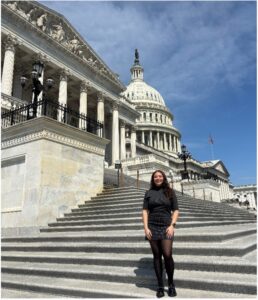
Jelis J. Sostre Cortés, AGU-sponsored CASE workshop participant in the U.S. Capitol. Credit: Elizabeth Goines.
I view planetary science as a means to better understand how unique Earth is. Each question answered about other planetary bodies in our solar system also reflects how incredibly lucky we are to be here. Similarly, my work with geohazards such as tsunamis, volcanic eruptions, and landslides has taught me the importance of sharing scientific knowledge to provide potentially life-saving information to vulnerable communities.
I am not interested in doing science merely for the sake of doing science; my goal with my research is to help make science a transparent and accessible tool so that the general public feels empowered and informed, rather than intimidated by it. An informed public is a resilient public, capable of making better decisions for their families and communities.
However, scientific research tends to remain in scientific journals or within institutions and struggles to reach the public, especially in rural areas and underrepresented communities. Sometimes it even loses its original message once it filters down to the general population. Isolating people from the scientific and decision-making processes results in a population that feels science and policy have nothing to do with them, leading them to lose their voice. Once this happens, a vicious cycle of isolation and disconnect begins, in which advocating becomes seen as unattainable for the general public, and resentment towards government and institutions builds.
In recent years, the challenge of defending science and education has become increasingly evident, particularly amid significant budget cuts affecting these areas. Such cuts, along with growing attacks on scientific integrity, are driving many skilled, highly qualified scientists and students to seek opportunities abroad. This trend should be of concern to policymakers and the general public alike, as it jeopardizes the United States’ standing as a global leader in science and technology, which, unlike many other countries, has traditionally prioritized transparency and the freedom to openly share our discoveries with the world.
To help combat this disconnect, I attended the AAAS Catalyzing Advocacy in Science and Engineering (CASE) Workshop in the Washington, D.C. area on April 12-15. The workshop featured speakers from various organizations and institutions, each sharing their expertise in science policy and effective advocacy. Learning about the Legislative process in a dynamic environment has empowered me to be a more effective advocate for science. Participating in the CASE workshop has equipped me with the necessary skills to find common ground with policymakers and collaborate towards a shared goal.
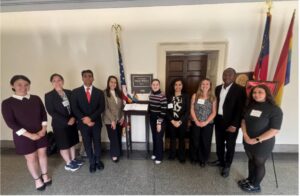
CASE workshop participants from the Georgia delegation during Congressional Visits. Credit: Elizabeth Goines.
Through this program, I had the opportunity to meet with our representatives in Congress to advocate for science and share my story: I came to Georgia Tech through the AGU Bridge Program to specialize in planetary geology and geohazards, with the long-term goal of returning home to share my science. Sharing that story reminded me of a core truth in my field: just as we rely on physical measurements and fieldwork to ground-truth our remote sensing data, we must also ground-truth our science in the real world through active policy engagement. Advocating for science and education is currently more important than ever in the United States. True accessibility means breaking down the language barriers and overcoming “academic gatekeeping” that often prevents underrepresented communities from engaging with crucial information.
It is our responsibility as scientists and engineers to bridge the gap between research and communication, ensuring that our findings reach policymakers and the general public. At the same time, policymakers must be willing to listen and seek out the evidence necessary to make informed decisions. Both groups, however, need to improve their communication skills and outreach efforts. Ultimately, scientists need to burst their academic bubble and share their knowledge with policymakers and the general public. After all, what is the purpose of science if not to seek advancement towards a better society?


